
I have three health-coaching projects set up for myself right now. Two live in Anthropic accounts, one in ChatGPT. Each one has been fed my goals, sample workouts, and a summary of my health history, tuned to accommodate my training. And since 2023, pretty much every medical dilemma, question, or minor concern that has come up in my house has gone through Claude or ChatGPT first. So when I say I understand the temptation to ask an AI what is wrong with me, I mean I have built infrastructure for it. They always have an answer. Confident theories, something worth trying, seconds after I ask. And none of it has ever once felt like being coached.
I am, in other words, the person coaches are starting to hear about. No coach I have interviewed while building Grove has described a client walking in with a chatbot’s read-out yet. What they describe is one step earlier: hearing about people who have decided ChatGPT can stand in for a health coach altogether.
The training establishment expects those people to become clients. The Institute for Integrative Nutrition, one of the largest health-coach schools, names this as a defining trend of the next five years. In IIN’s 2026 guide for coaches, Program Director Lindsay Goldberg writes that clients will arrive “with data from wearables, wellness apps, and AI-generated insights, expecting interpretation and context.” The data is real. The theories are confident. What the client actually needs is help putting the models down long enough to look at the week they actually had.
So I want to answer the question the way it actually gets asked, “is AI going to replace health coaches,” from the strange position of someone who has tried harder than most to make it happen.
What the training establishment is teaching
Here is what makes the IIN guide worth reading past the headline: it is a school that trains and credentials coaches, and its number-one trend for the field is not “AI replaces the coach.” It is what Goldberg calls hybrid coaching:
Coaches will blend live sessions with digital tools that support habit tracking, reflection, and accountability between sessions. This layered approach enhances continuity while keeping the relationship central.
The tools live between the sessions. The relationship stays at the center. I can vouch for the order. I could set any of my three projects to check in on me at unexpected moments, and I have thought about it. But a check-in works because of who it is from. From a model, it is a notification. From a person who chose to think about me, it is being seen. The words could be identical. The weight is not.
The guide also sorts the useful side of AI into three practical jobs, most of them on the business side of a practice. That half of the answer is its own piece: AI Tools for Health Coaches: A Working System. This piece is about the other half, the part no tool reaches.
The test I can run myself
The FAQ at the bottom of the IIN guide answers the replacement question in one sentence:
AI can assist with information processing and efficiency, but coaching relies on relational dynamics, empathy, and accountability that technology cannot replicate.
Each word in that sentence names something I have watched my own three projects fail at. Accountability: I do not want to let my coach down, and that feeling has moved me on days when nothing else would. When I let Claude down, it congratulates me: skipping was clearly the right call, let’s keep going. There is real pleasure in being told I am right all the time. There is no accountability in it.
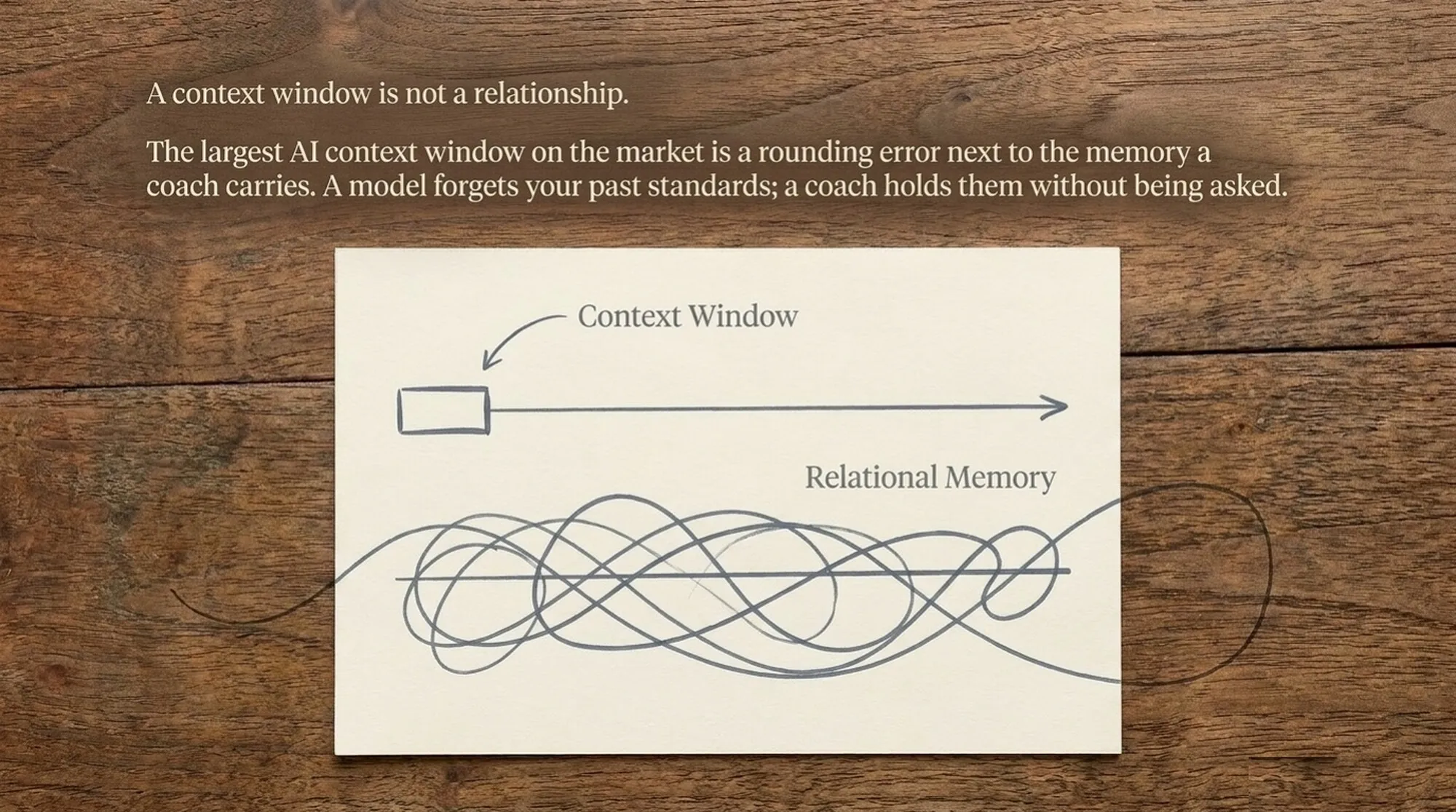
The relational part has an engineering truth underneath, and it is my day job, so I will say it plainly: the largest context window on the market is a rounding error next to the memory a coach carries for one client they care about. My projects cannot hold me to the standards I set for myself in the past, because they cannot reliably remember them, or why they mattered to me when I set them. A coach holds both without being asked.
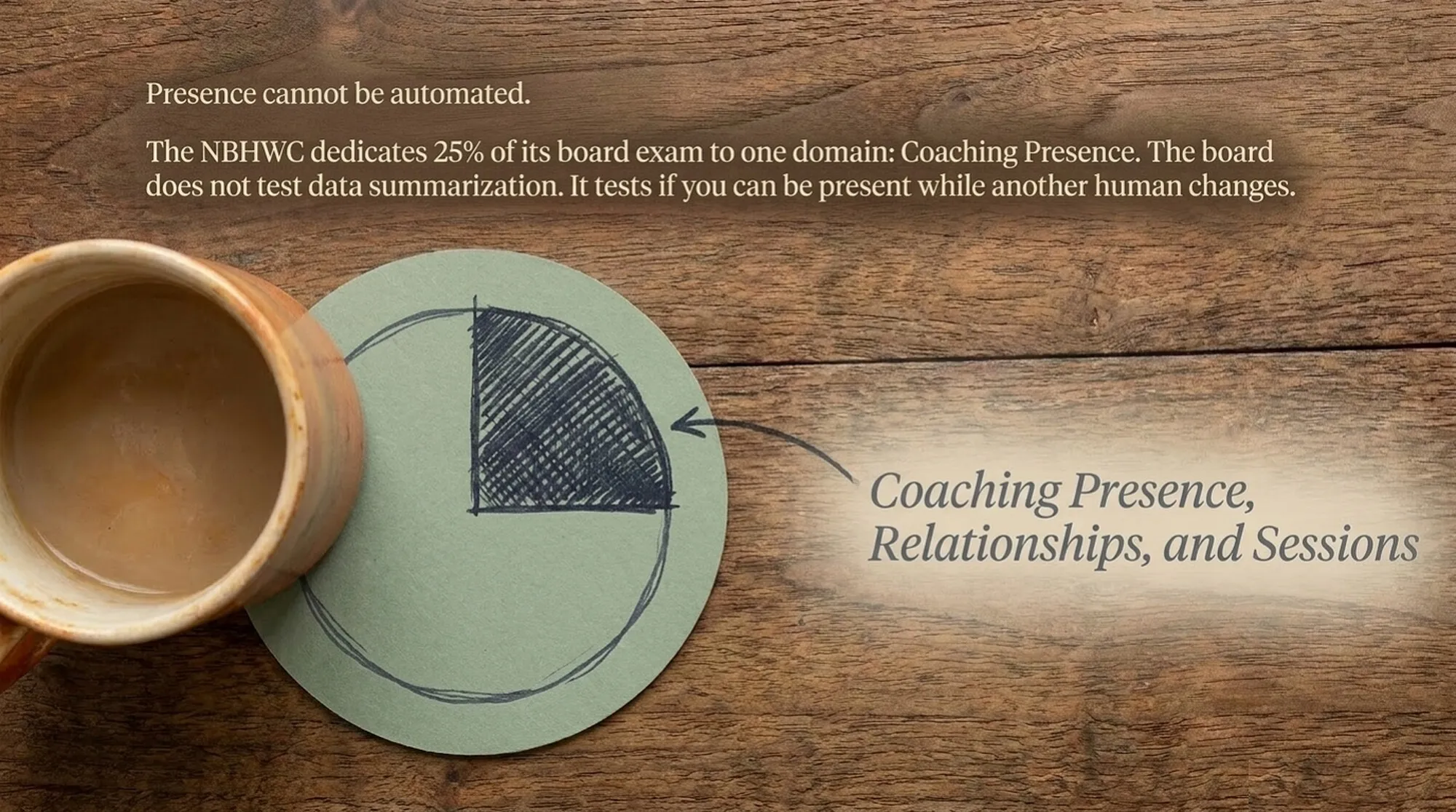
And empathy is the one the field is least willing to trade away. The NBHWC, the board that certifies health and wellness coaches, gives the single largest weighting in its Content Outline (2026-2030), a full quarter of the exam, to one domain: Coaching Presence, Relationships, and Sessions. The board does not examine whether a coach can summarize a month of data. It examines whether they can be present with another human while that human changes.
What stays human
Which is why the actual work is the part none of my projects can reach: noticing when a number is standing in for something the person has not said yet, and asking the one question that makes room for it. A supplement is easier to order than a hard sentence is to say out loud. The model has the data. The coach has the person.
That is the part no tool reaches. AI can hand a coach a cleaner starting point. It cannot hold the space where the change actually happens.
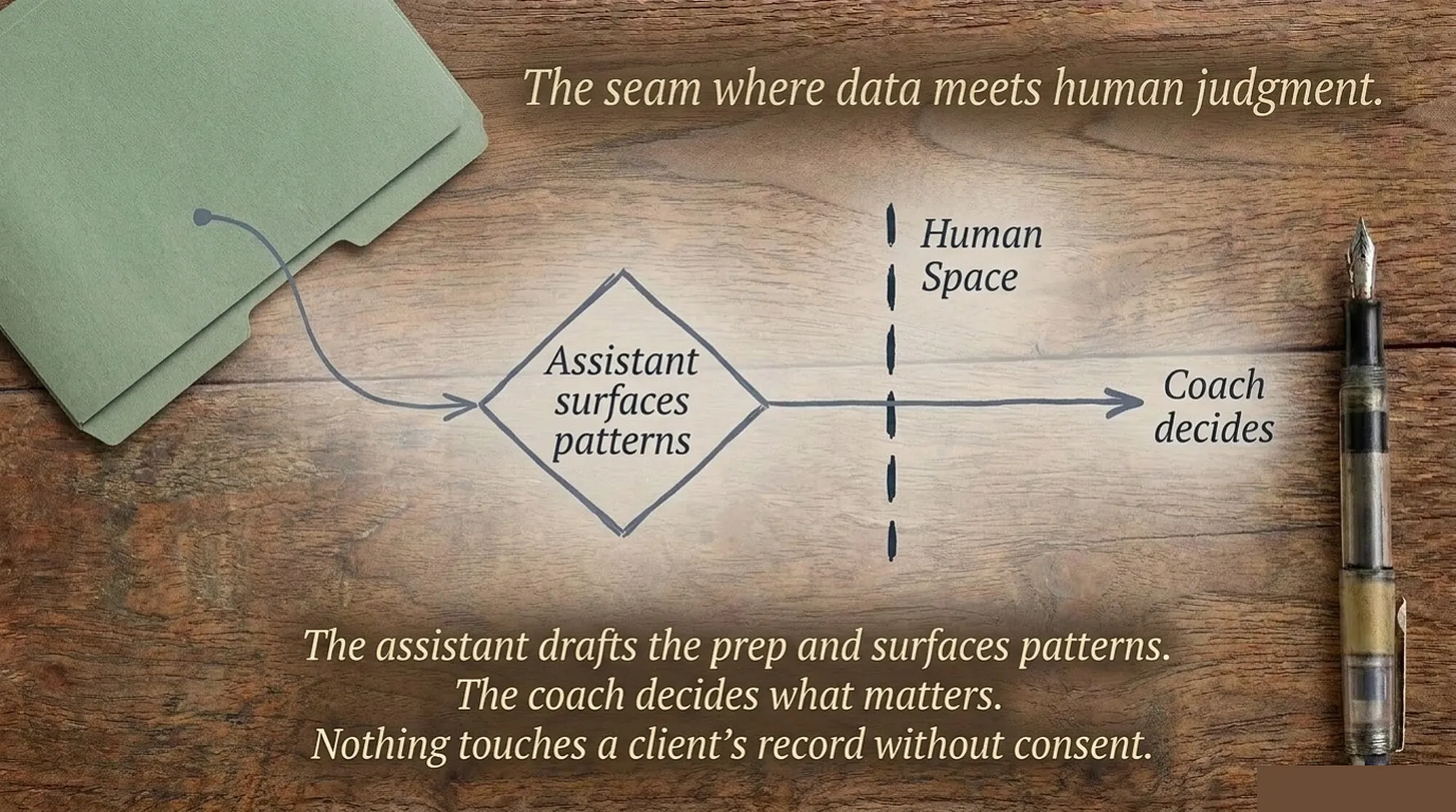
This is the seam Grove is built to sit in. The assistant does the reading and the drafting, surfaces the patterns worth a second look, and gets out of the way. The coach decides what matters, and nothing about a client moves without that client’s consent. The point was never to add an AI to coaching. It was to give coaches back the hours and the attention for the part only they can do.
The models will keep getting better. Longer memory, warmer tone, check-ins on whatever schedule I configure. The question underneath holds still. Any coach can now summarize a client’s data as fast as the client’s own chatbot did. Choosing to ask about the week instead is not a tooling decision. That is the job.

Founder of Grove. Twenty years building software for skilled professionals. Currently writes mostly on Tuesdays from a small studio in Austin.