
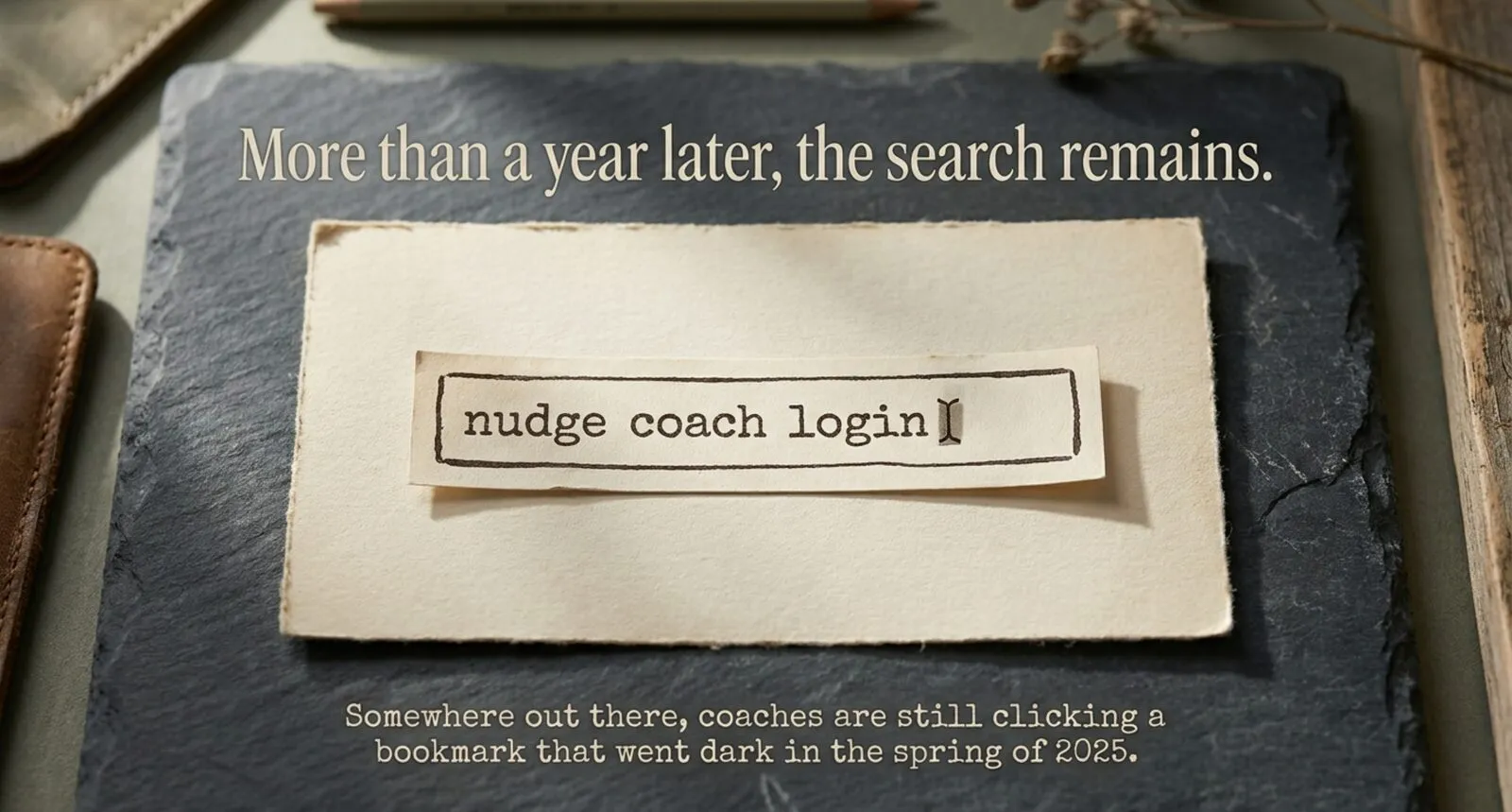
More than a year after Nudge Coach shut down, Google still autocompletes “nudge coach login.” Type the name and the suggestion list tells a small, quiet story: nudge coach app, nudge coach login, nudge coach alternative. Somewhere out there, coaches are still clicking a bookmark that stopped working in the spring of 2025.
The short version
Nudge Coach was a client engagement platform for health and wellness coaches: a configurable app your clients installed on their own phones, with trackers, daily check-ins, content cards, and group coaching. It was one of the few tools in this space built client-side first, and a lot of coaches ran their practices on it.
On April 30, 2025, it shut down. The founders, Phil Beene and Mac Gambill, closed with more grace than most software companies manage: gratitude for their coaches, a working export path, and a plain acknowledgment that they could not make the business sustainable. Coaches had until mid-May 2025 to download their data. Then the lights went out.
That is the whole factual story. The more interesting story is what the shutdown actually meant for the coaches standing on the platform when it happened.
If Nudge was your daily check-in tool and you are ready to look at what comes next, I put together an honest comparison of where displaced Nudge coaches tend to land, including the cases where Grove is not the right fit: Nudge Coach alternative, reviewed honestly.
What a shutdown actually breaks
I build coaching software, so I read a platform shutdown the way an engineer reads an incident report: less interested in the failure itself, more interested in what it reveals about where the load was really sitting.
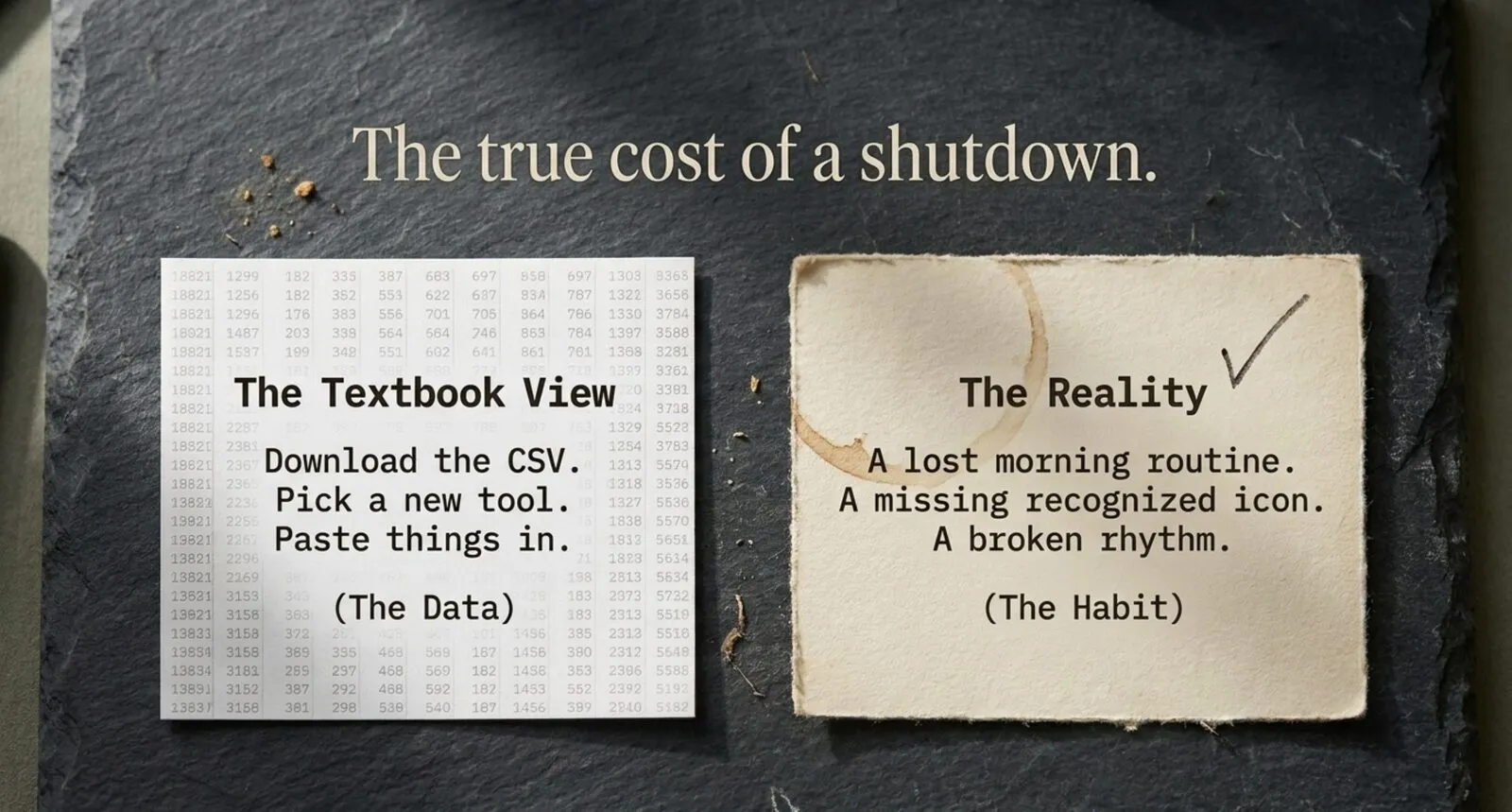
The textbook version of switching platforms is an export file and an afternoon. Download the CSV, pick a new tool, paste things in. Tidy.
The reality is that the platform was not holding data. It was holding habits. A client who checked in every morning had a specific place that check-in lived, on their own phone, under an icon they recognized. A coach who reviewed those check-ins on Tuesday afternoons had a rhythm built around where the information showed up. When the app went dark, the export file preserved the numbers and lost the practice. Clients mid-program did not experience a migration. They experienced their coach’s tool disappearing, which reads, from the client side, uncomfortably close to the coach disappearing.
That is the real switching cost, and it is why “just export your data” always understates what a coach loses when software dies.
What to look for in whatever comes next
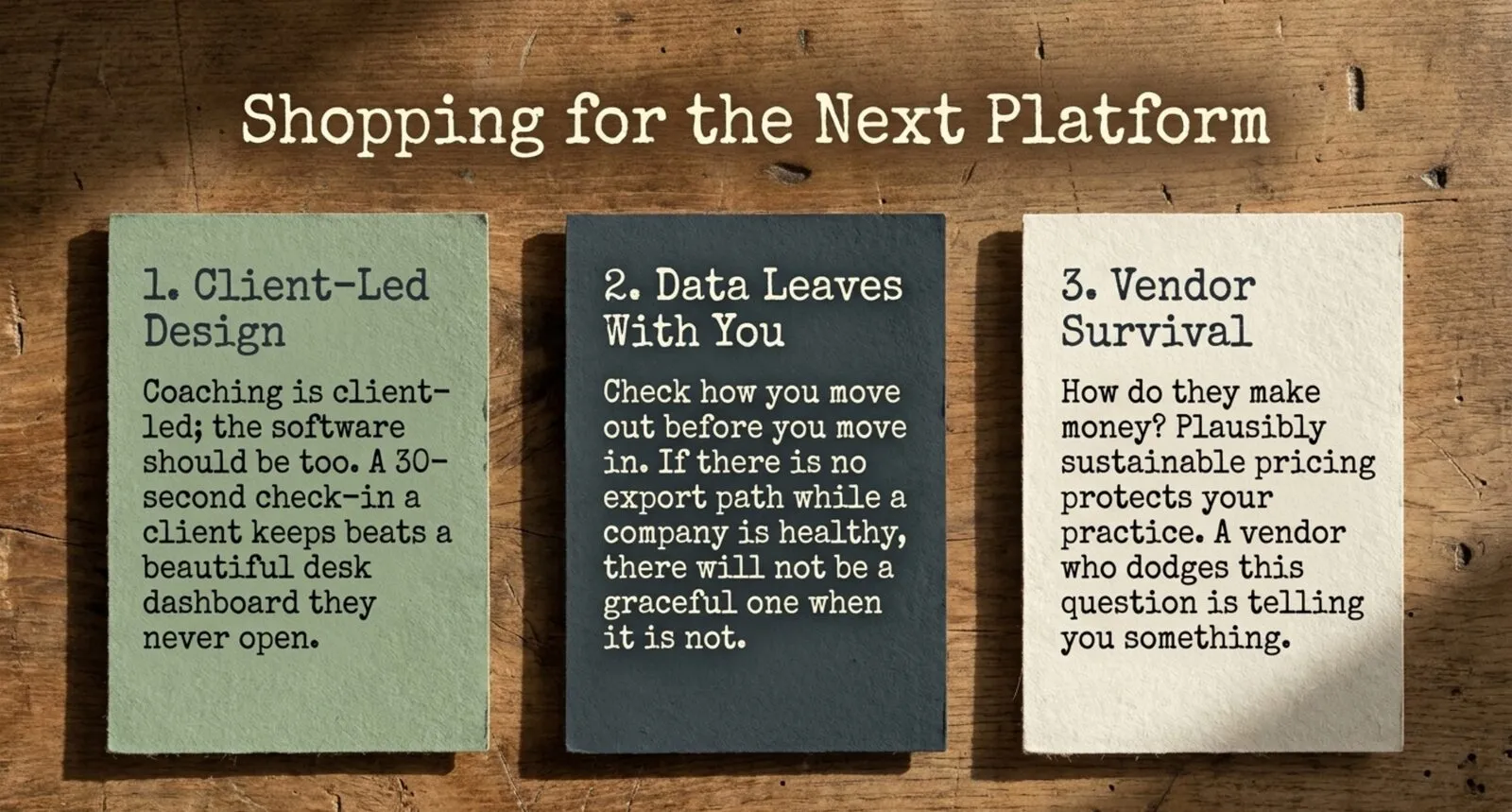
I build in the same category, so I have thought hard about what this shutdown should change in how a coach shops. Three criteria matter more than any feature list.
1. Coaching is client-led. The coaching platform should be too. Nudge got this right, and it is still rare. Most coaching software is built for the coach’s desk: records, notes, scheduling, billing. The client gets a portal they forget exists. If the thing you miss about Nudge is that your clients actually used it, make that the first test of any replacement. A thirty-second check-in a client keeps beats a beautiful dashboard they never open.
2. Your data leaves with you. Nudge handled its ending honestly: a real export window, announced in advance. Not every vendor will. Before you move in somewhere new, check how you would move out. If there is no export path while the company is healthy, there will not be a graceful one when it is not.
3. Understand how the vendor stays alive. This one is uncomfortable to write as a founder, but it is the honest lesson of the shutdown. Nudge did not fail its coaches on product. It ran out of business. Whatever tool you pick next, it is fair to ask how it makes money, whether the price you pay could plausibly sustain the service you receive, and what happens to your practice if the answer changes. A vendor who welcomes that question is telling you something. So is one who dodges it.
The health-coach migration, specifically
A health or wellness coach searching for a Nudge Coach alternative is not shopping for features in the abstract. You have clients mid-program, a check-in rhythm that was working, and a closing window on the data you can still pull. So the migration comes down to one question asked twice: what was Nudge actually doing for you, and where does that specific job live now?
For most of the coaches who miss it, the job was the engagement pole: a client-side app, a daily check-in, a coach reading those check-ins and replying. If that is you, look for another client-led tool, not a coach’s admin dashboard with a client portal bolted on. The engagement-pole coaches have the most to lose in a move and are the least served by the practice-management platforms that fill these search results, because those are built for the coach’s desk, not the client’s phone. For the smaller group who used Nudge for clinical records, intake, or billing, a practice-management platform is the honest answer, and you will be happier there.
Either way, run the data-export step first, before you fall for a new tool. Not because you will reopen the CSV, but because it is the cheapest test of the thing that actually ended Nudge for its coaches: whether a vendor makes it easy to leave, and whether the price you pay could plausibly keep the service alive. That second question is fair to ask out loud, which is why our pricing is public.
Where Grove fits, plainly
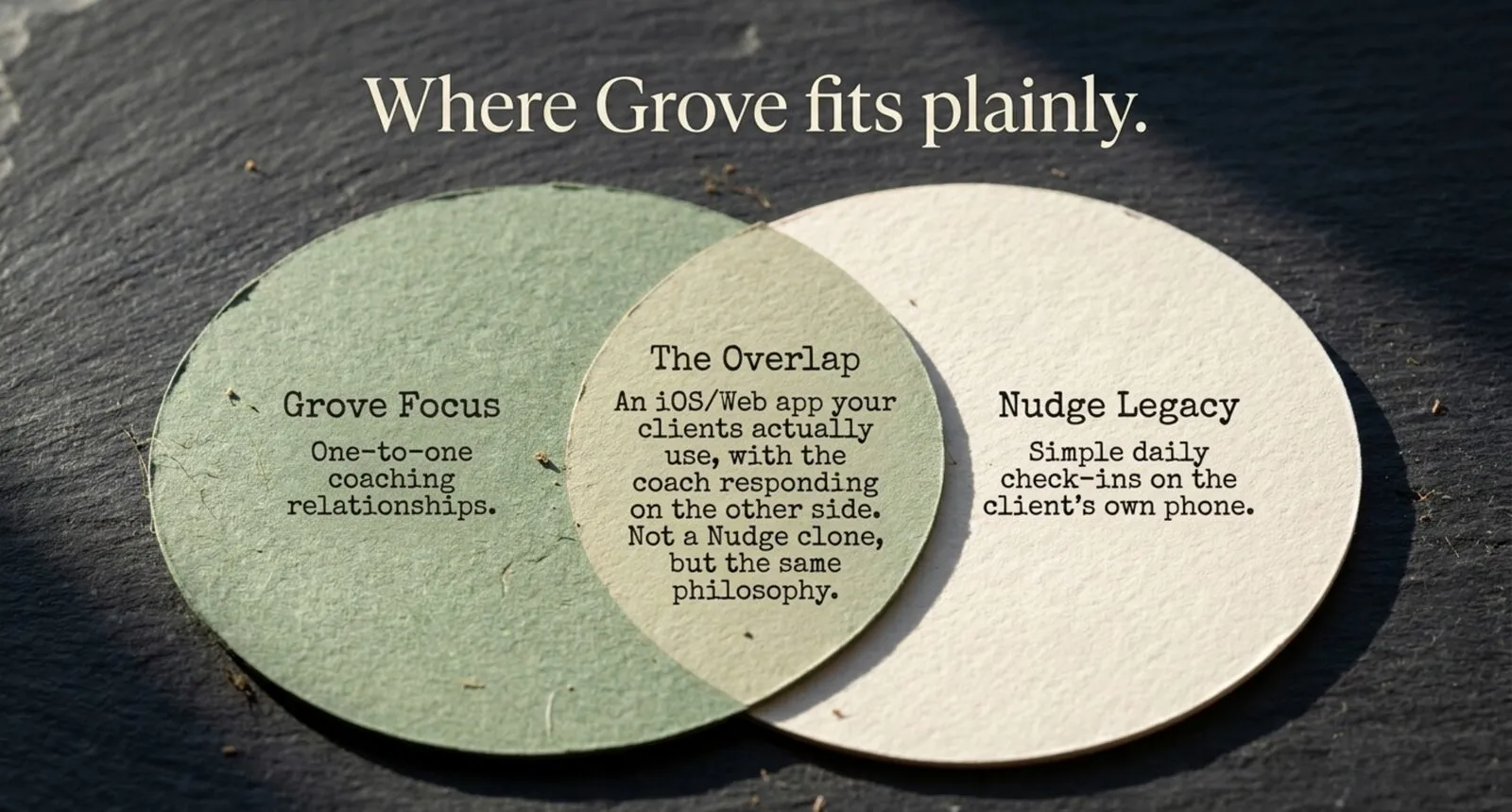
Grove overlaps most with the part of Nudge that coaches seem to miss most: a simple daily check-in clients actually keep, in an app on their own phone, with the coach responding on the other side. The client app is on iOS today, and the web app covers everyone else. It is not a Nudge clone. If group programs were the center of your practice, Grove is built around the one-to-one relationship, not cohorts, and you should weigh that honestly. I keep a fuller comparison at the Nudge Coach alternatives page, including the cases where a clinical platform is the better home.
And since this post is literally about a vendor dying, it is fair to hold Grove to the same three criteria. Our answers to the exit questions, including what happens if Grove ever winds down, are written down on our trust page.
The autocomplete will fade eventually. Someone’s last bookmark will finally get replaced, and “nudge coach login” will stop being a phrase anyone types. The criteria are worth keeping longer than the search term. Platforms are mortal. The practice of showing up between sessions belongs to the coach, not to the software. The tool’s job is to hold that practice well while it is here, and to hand it back intact when it is not.

Founder of Grove. Twenty years building software for skilled professionals. Currently writes mostly on Tuesdays from a small studio in Austin.