

One of the first coaches I interviewed while building Grove showed me how she got paid: scheduling in one tab, payments in another, and a spreadsheet connecting the two, where she tracked who had paid and how many sessions everyone had left by hand. She knew every number in it. She also knew what it cost her to know: a reconciliation ritual every week, and a low hum of doubt in between.
Another coach handed me the clearest product requirement I have ever received, four words long:
“Send it, they pay.”
So I went looking at what the market offers a coach who wants exactly that. The search results tried to sell her an insurance department.
Before you choose billing software, ask one question: who actually pays you? If the answer is usually the client, you probably do not need software designed around claims.
The billing software you find is shaped by insurance
Search “billing software for health coaches” and the results split two ways. Half are listicles ranking a dozen invoicing tools. The other half are practice-management platforms built for clinical work: superbills, CPT codes, claims workflows, HIPAA-compliant records. Serious machinery, built for a real job.
That job is third-party reimbursement, which requires structured documentation of what was provided and why. The machinery makes sense when a payer sits between practitioner and client.
A typical solo, cash-pay coaching practice has a different transaction: the client pays directly, with a card, for sessions and packages they chose. No claim, no adjudication, no code. When a cash-pay practice adopts insurance-shaped software, the coach inherits the paperwork of a reimbursement system she may not participate in. The tool’s complexity becomes rent paid to someone else’s business model.
What about the Medicare news?
In July, CMS proposed paying for health and well-being coaching under Medicare starting in 2027. Read the fine print, though. The proposal does not let a coach bill Medicare on her own. The coaching would be delivered by a board-certified coach as auxiliary personnel and billed by a supervising physician or other Medicare practitioner, using three coaching codes that have existed since 2020. If it lands, the coach who bills through it will be working inside a practice that already has a claims department. For a solo, cash-pay practice, the question stays the same: who pays you?
There is real recognition in the proposal all the same: CMS names the national credentialing standards directly, including the National Board for Health and Wellness Coaching’s, which reflects years of work to establish coaching as a profession. And it is still a proposal; comments are open through September 14 (file code CMS-1848-P), and a final rule would come this fall. If you want a say in how coaching enters Medicare, that docket is where to send it.
What getting paid actually requires
Strip the insurance machinery away and a cash-pay practice needs four things.
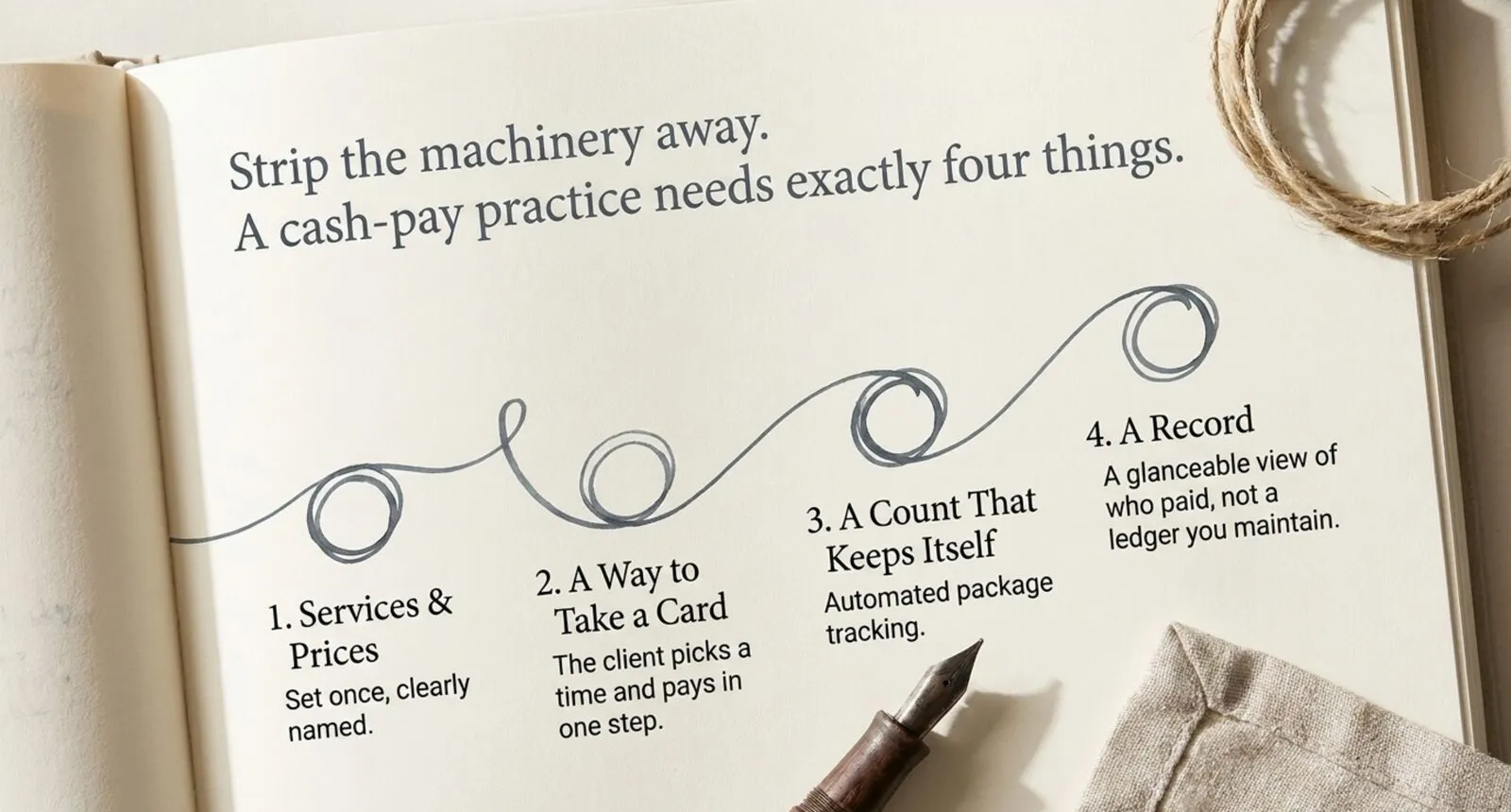
1. A clear set of services and prices. Your session types and packages, each with a name, a duration, a price, and a description that reads like you wrote it. Set once, shown wherever a client books.
2. A way to take a card. The client picks a time and pays in one step. The payment processor handles the sensitive card data; you should not have to.
3. A count that keeps itself. Packages are where the spreadsheet doubt lives. A client buys six sessions, and someone has to know when five are gone. That someone should not be you at 9pm with a spreadsheet open.
4. A record of who paid. Not a ledger you maintain. A view you glance at: collected, pending, and which packages are running low.

For many cash-pay practices, that is most of the requirement. The rest of the billing-software category is built for insurance work, or for a business shaped very differently from a solo coaching practice.
The quiet mistake: health detail on invoices
The insurance-shaped tools push in one more direction worth resisting. A superbill wants a diagnosis on it, because a claim needs one. Coaching invoices need the opposite.
An invoice travels. It gets forwarded to a bookkeeper, a spouse who handles the family finances, sometimes an employer with a wellness stipend. A line item that says “Deep Dive, 90 minutes” reveals very little. A line item that mentions a condition, a goal, or anything from inside the coaching relationship reveals much more. The principle worth keeping: put only as much client information on an invoice as the transaction requires. The rest of the story belongs to the client, in the room, not on a PDF in someone’s accounting inbox.
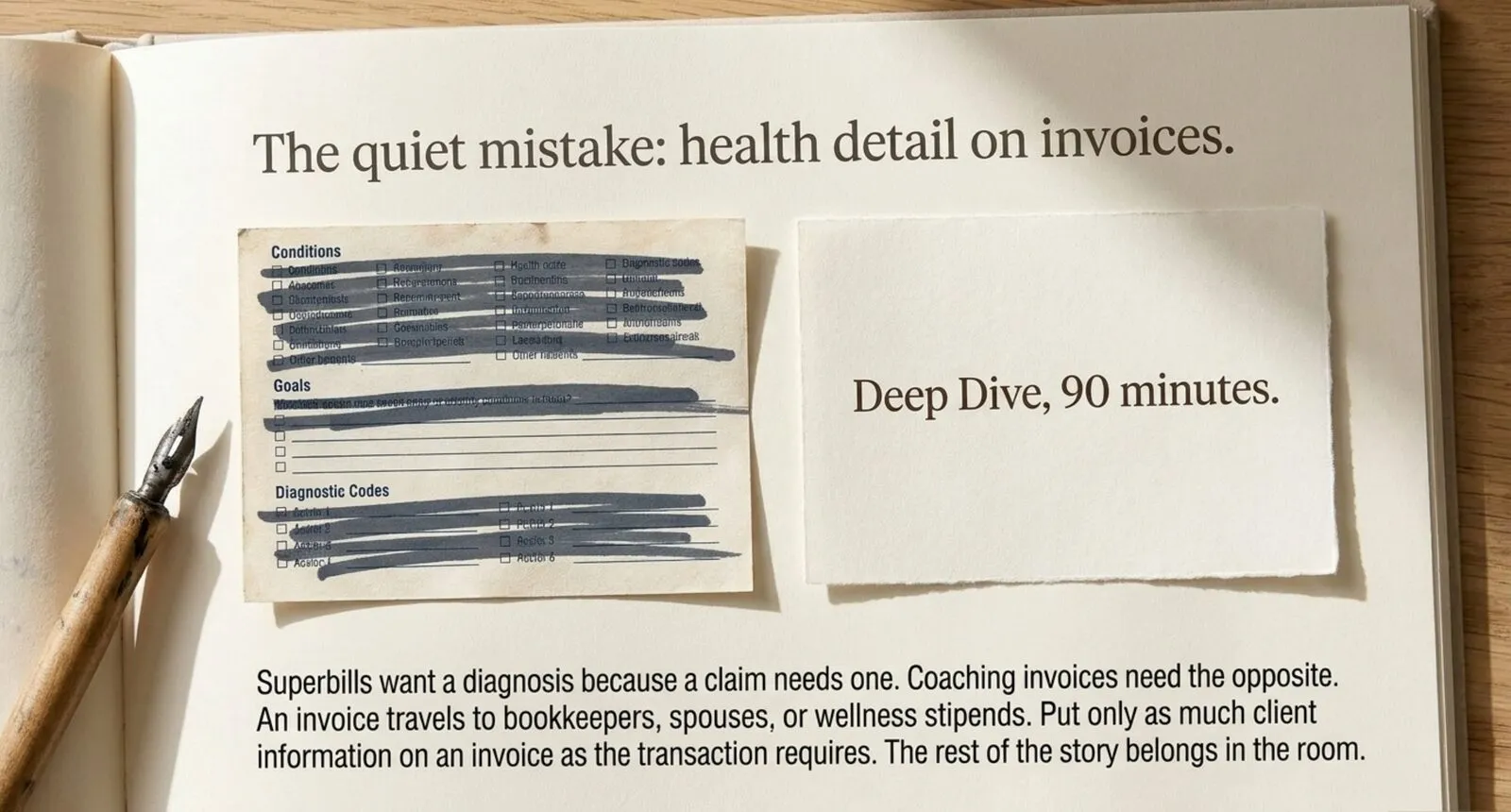
This came up in enough coach conversations that we made it a design decision rather than a suggestion. When we built invoicing into Grove, we put the reminder right under the line-item field.
What we built, since I mentioned it
Grove’s version of this is deliberately small. You set up your sessions and packages once. A client books and pays in one step through Stripe. Packages keep their own count, one-off invoices handle the exceptions, and the Payments tab shows who has paid. No spreadsheet reconciliation required. The setup guide takes about twenty minutes.

But the point holds whatever tool you use. If your practice is cash-pay, you are allowed to want billing that matches it: services and prices, a card, a count, a record.
The shape of the tool is a theory about your practice
I have come to read billing software the way I read any system: the design tells you who it was built to satisfy. Superbills satisfy payers. Claims workflows satisfy clearinghouses. A spreadsheet with a hand-updated sessions-remaining column satisfies nobody, least of all the coach maintaining it on Sunday evening.
“Send it, they pay” is a theory too. It says the client is the payer, the relationship is direct, and the money should move the way the coaching does: simply, between two people who trust each other. Pick the tool whose theory matches your practice.

Founder of Grove. Twenty years building software for skilled professionals. Currently writes mostly on Tuesdays from a small studio in Austin.