
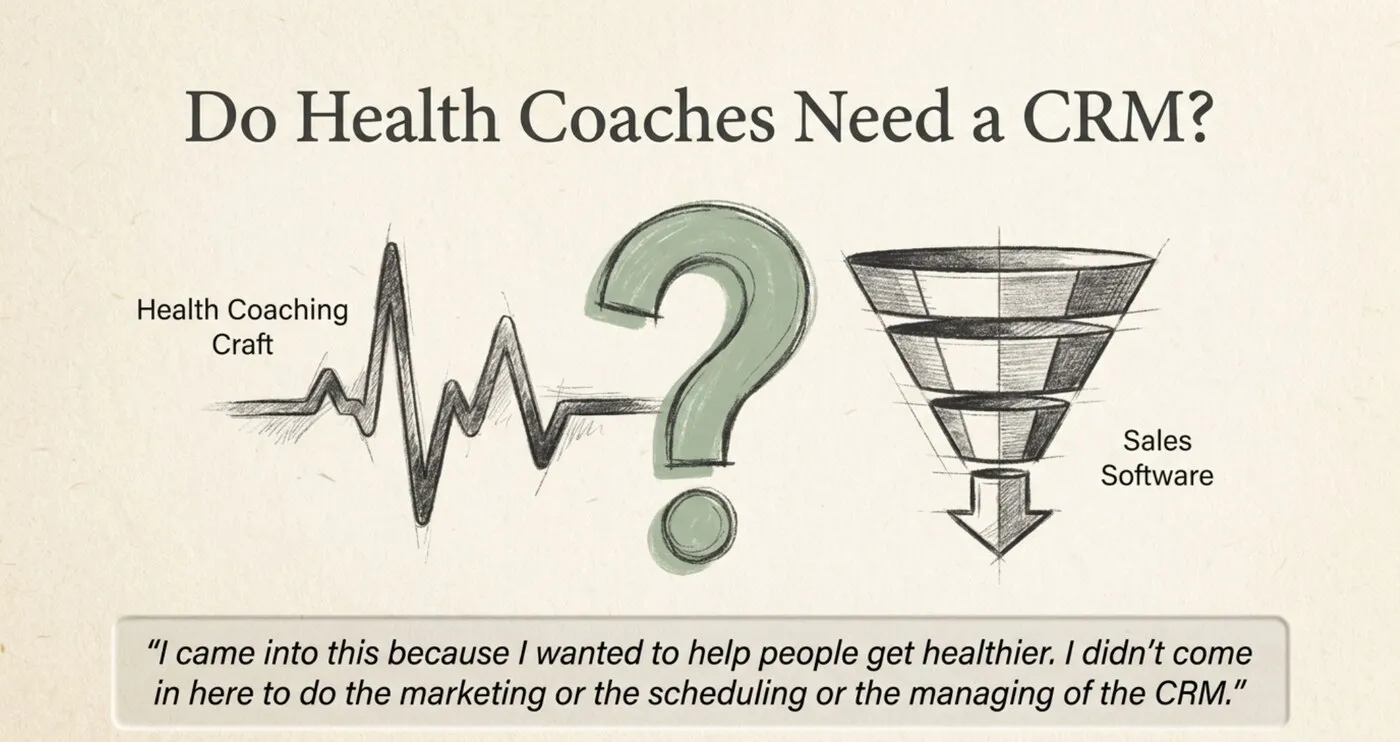
A coach I interviewed while building Grove said the quiet part at full volume:
I came into this because I wanted to help people get healthier. I didn’t come in here to do the marketing or the scheduling or the managing of the CRM.
She is good at the work. She is also, on paper, the owner-operator of a small software stack she did not pick, cannot fully edit, and thinks about more than she wants to. An agency assembled it for her. When she wants to change how a client moves through it, she files a request and waits.
So when a coach like her asks whether she needs a CRM, she is not asking a software question. Hold that thought, because the entire internet is about to answer the software question instead.
Everyone answering this is selling the answer
Search “do health coaches need a CRM” and look at who is talking. The whole first page is vendors: a list of twelve tools ranked, a “best CRM for coaches” roundup, a software company explaining with real warmth why the thing they sell is the thing you are missing. One of them says it plainly: a CRM is a must-have for any coach at any stage, and you are never too new to need one. The verdict is unanimous. Of course you need one. Here is ours.
Unanimity like that should make you suspicious, not comfortable. A question whose every published answer is written by someone who profits from “yes” is not a settled question. It is an unexamined one.
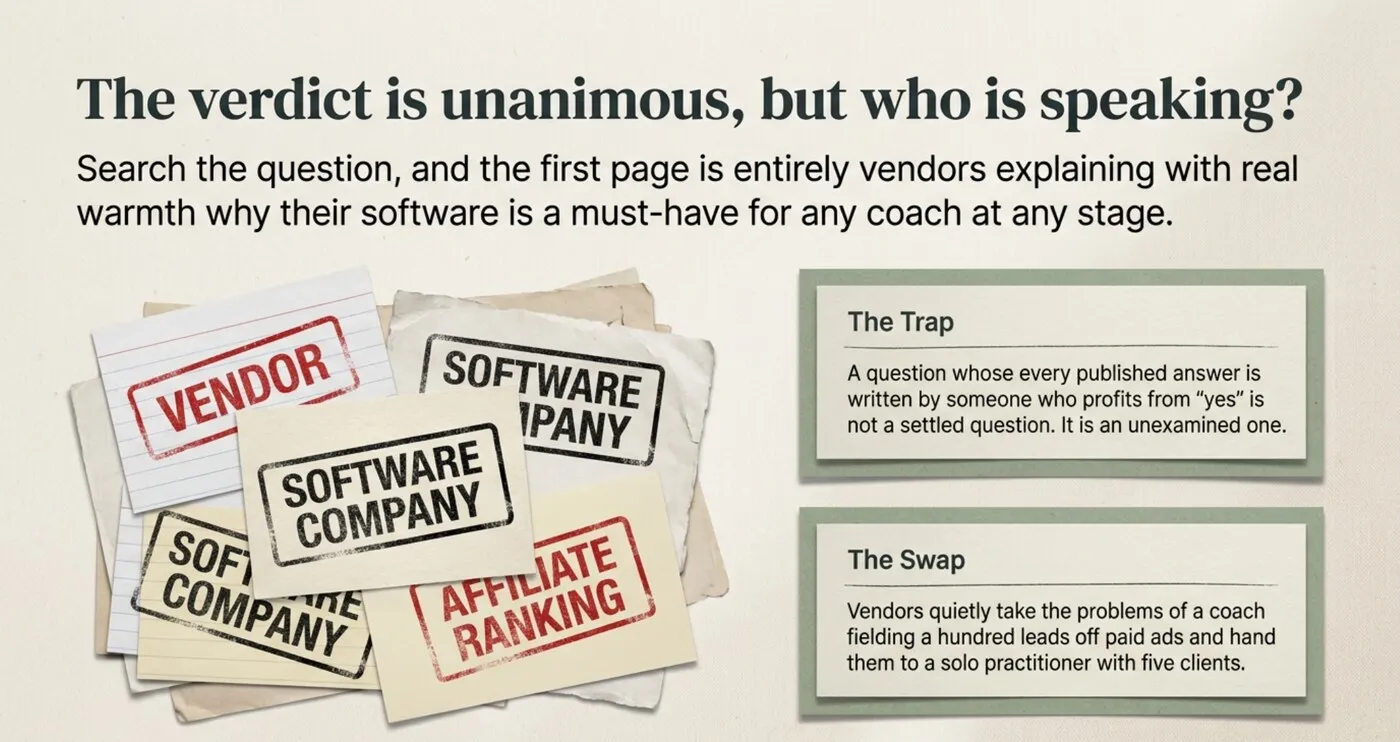
The honest answer is quieter and turns on what you are actually trying to do. A board-certified health coach with five clients and a calendar that fits on one screen has a different problem than a coach fielding a hundred leads off paid ads. Most of these posts are written for the second coach and quietly handed to the first. That swap is the whole trick.
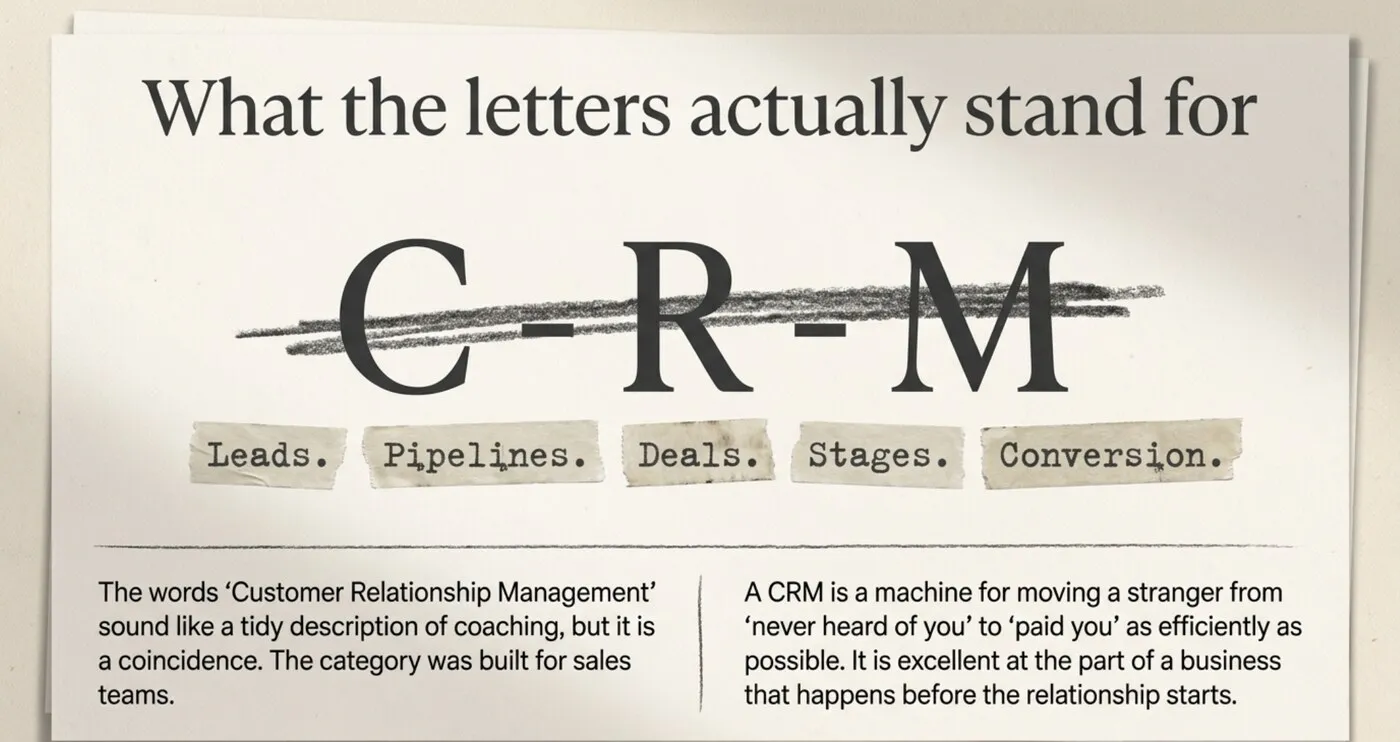
What the letters actually stand for
CRM means customer relationship management, which sounds like a tidy description of coaching. The words are a coincidence. The category was built for sales teams, and its vocabulary gives the game away: leads, pipelines, deals, stages, conversion. A CRM is a machine for moving a stranger from “never heard of you” to “paid you,” as efficiently as possible, then doing it again at volume. It is very good at the part of a business that happens before the relationship starts.
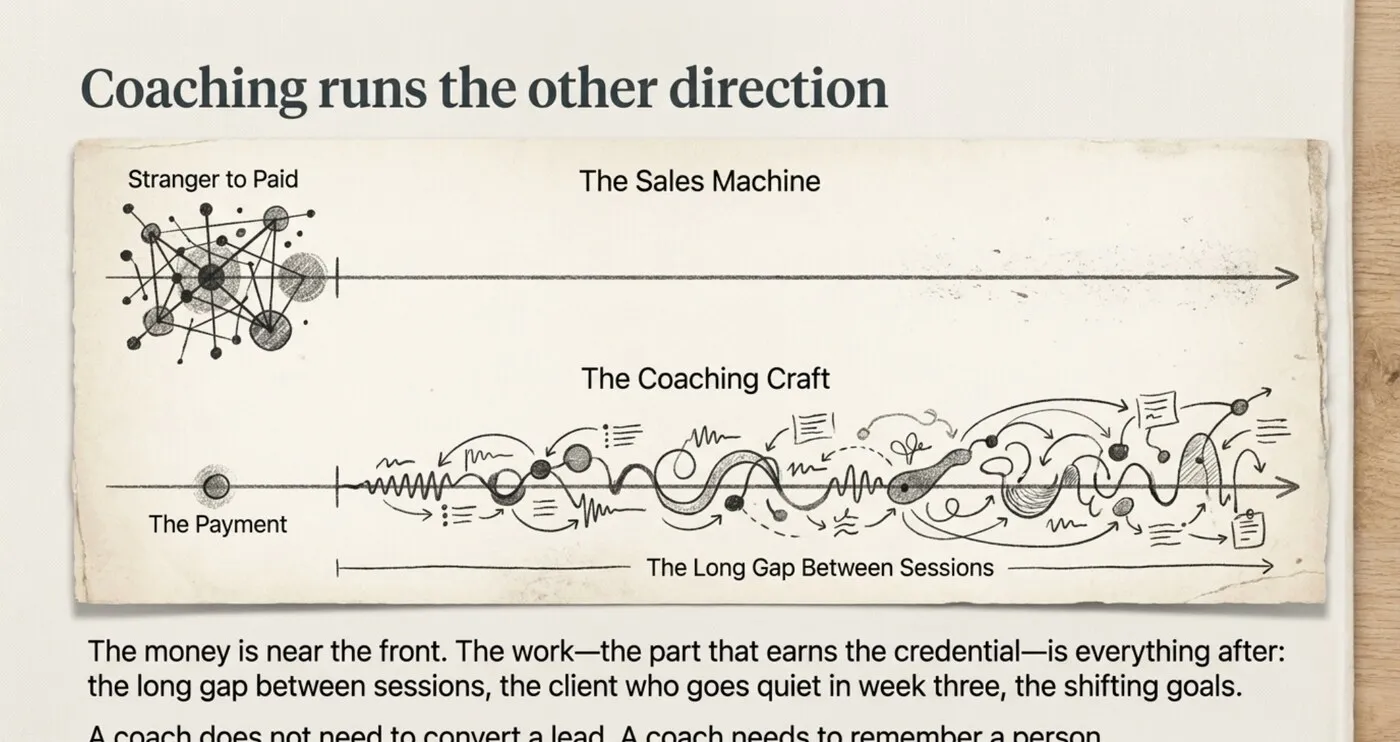
Coaching runs the other direction. The money is near the front. The work, the part that earns the credential, is everything after: the long gap between one session and the next, the client who goes quiet in week three, the goal that was never really about the number on the scale. A coach does not need to convert a lead. A coach needs to remember a person.
Those are different machines. You can run a relationship on a sales tool, and plenty of coaches do, because it is the stack someone handed them. It also explains a feeling I keep hearing in interviews: that the software is one more thing to manage on top of the coaching, rather than something that helps the coaching happen.
The question under the question
When a newer coach asks “do I need a CRM,” she is usually asking one of three things. Naming which one changes the answer.
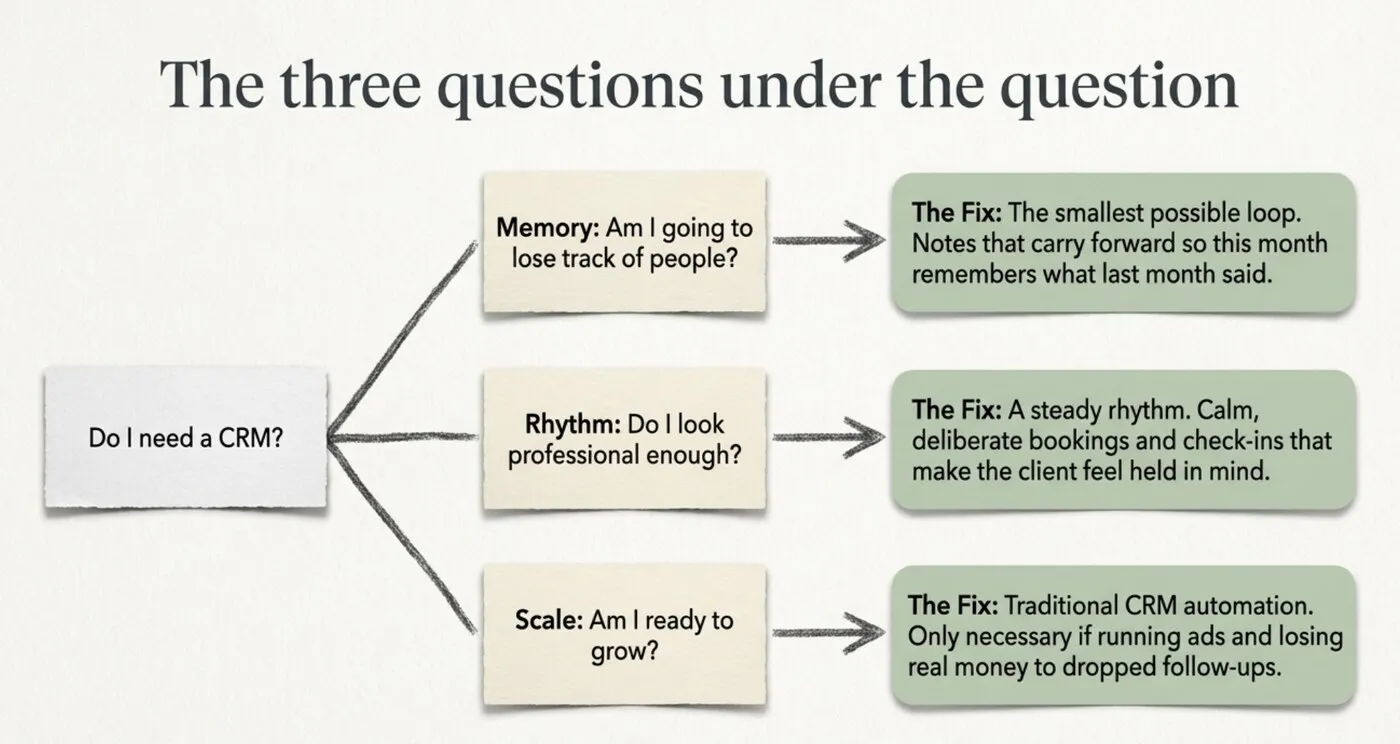
Am I going to lose track of people? This is the real fear, and it is a fair one. The dread is not about pipelines. It is a client mentioning at the end of a call that sleep has been rough lately, and that thread being gone by next week because there was nowhere to put it. That is a memory problem, not a sales problem. The fix is the smallest possible loop: notes that carry forward, so this month remembers what last month said, and a place for what happens between sessions to land. A spreadsheet does this badly. A sales CRM does it expensively. A tool built for coaching does it as the main event.
Do I look professional enough? Also fair, and also not a CRM question. What a client feels is the booking, the check-in, the message that arrives at the right moment, the sense of being held in mind. None of that needs a pipeline view. It needs the few client-facing moments to feel calm and deliberate. A coach with a steady rhythm reads as more established than a coach with a sprawling dashboard and nothing following through.
Am I ready to grow? This is the only version a traditional CRM is built to answer, and it shows up later than the marketing implies. If you are running ads, fielding more inquiries than you can answer by hand, and losing real money to dropped follow-ups, the automation starts to pay for itself. Before that, it is a monthly bill for capacity you are not using and a second job keeping it tidy.
The cost nobody lists is control
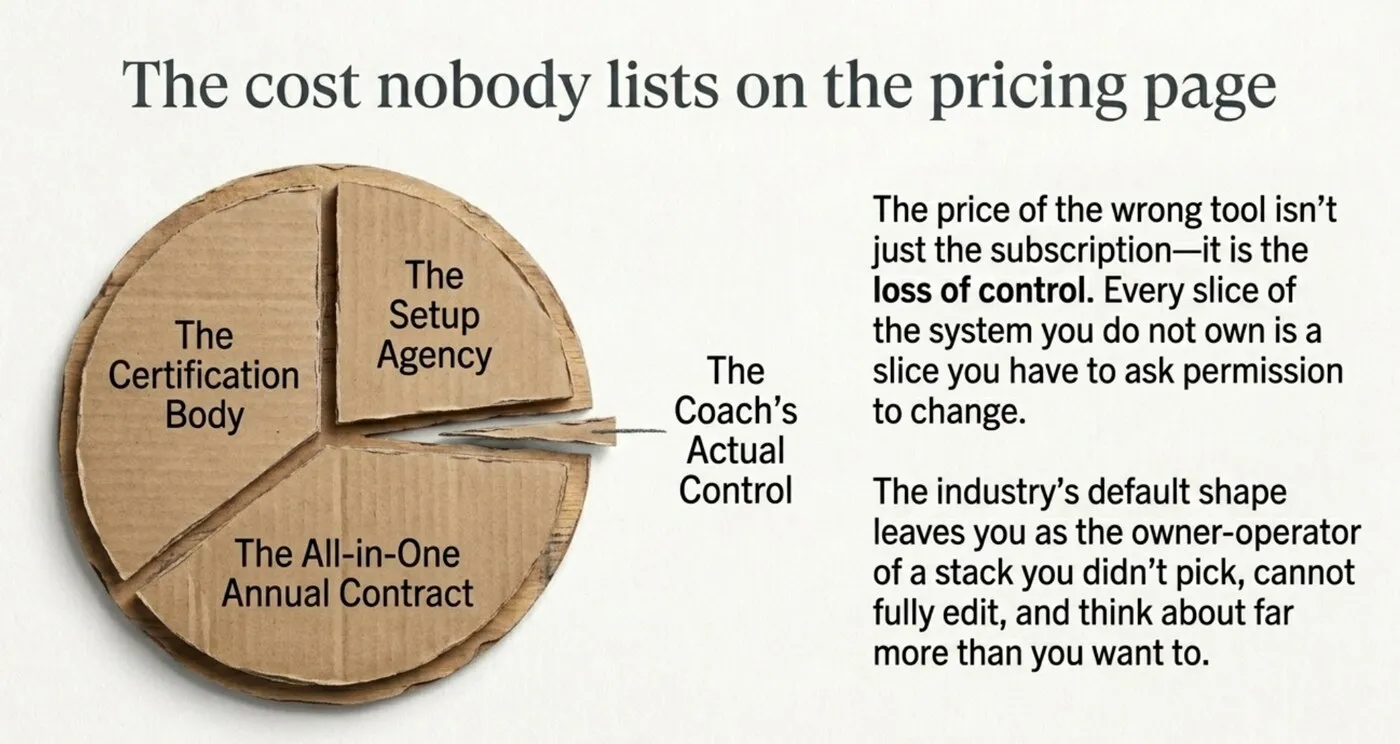
Here is the part the roundups leave out. The price of the wrong tool is not only the subscription. It is the loss of control, and that one does not show up on the pricing page.
The coach I interviewed cannot change her own stack without going through someone else. The certification body she trained with, the agency that set her up, the all-in-one platform with the annual contract: each was glad to own a slice of how she runs her practice. Every slice she does not own is a slice she has to ask permission to change. None of them did anything villainous. Each took a reasonable-looking piece, sold competently, and the practice ended up assembled from parts she does not hold the keys to. That is the industry’s default shape, not her mistake.
The coaches who seemed most at ease with their tools had the opposite arrangement. They owned the relationship, the client list, the rhythm, and they could change any of it on a Tuesday afternoon without filing a ticket. The tool served the practice. Not the reverse.
So the sharper first question is not “which CRM.” It is “what is the smallest reliable system that keeps a handful of clients in view, runs a dependable loop, never loses the thread, and stays fully mine at a roster of one.” Answer that, and most of the twelve-tool comparisons stop applying to you.
So, do you need one?
If “CRM” means a sales pipeline with lead scoring and automated nurture sequences: not yet, and maybe not ever, depending on how you choose to grow. At client zero through five, that machine solves a problem you do not have and hands you one you do.
If “CRM” is just the nearest word you had for “somewhere to keep my clients and remember what is happening with them,” then yes, obviously. Everyone needs that. Do not let the word talk you into buying the sales version of it. The coaching itself works, and the gains hold up over time across years of trials. What belongs around it is the smallest system that keeps the relationship in view, not the biggest one that keeps a pipeline moving.
You did not get certified to run a CRM. You got certified to coach, and the credential on the wall says the craft is real. The software is supposed to disappear behind it. The day you notice you are managing the tool instead of the person, the tool is wrong, no matter how many lists ranked it first.

Founder of Grove. Twenty years building software for skilled professionals. Currently writes mostly on Tuesdays from a small studio in Austin.