
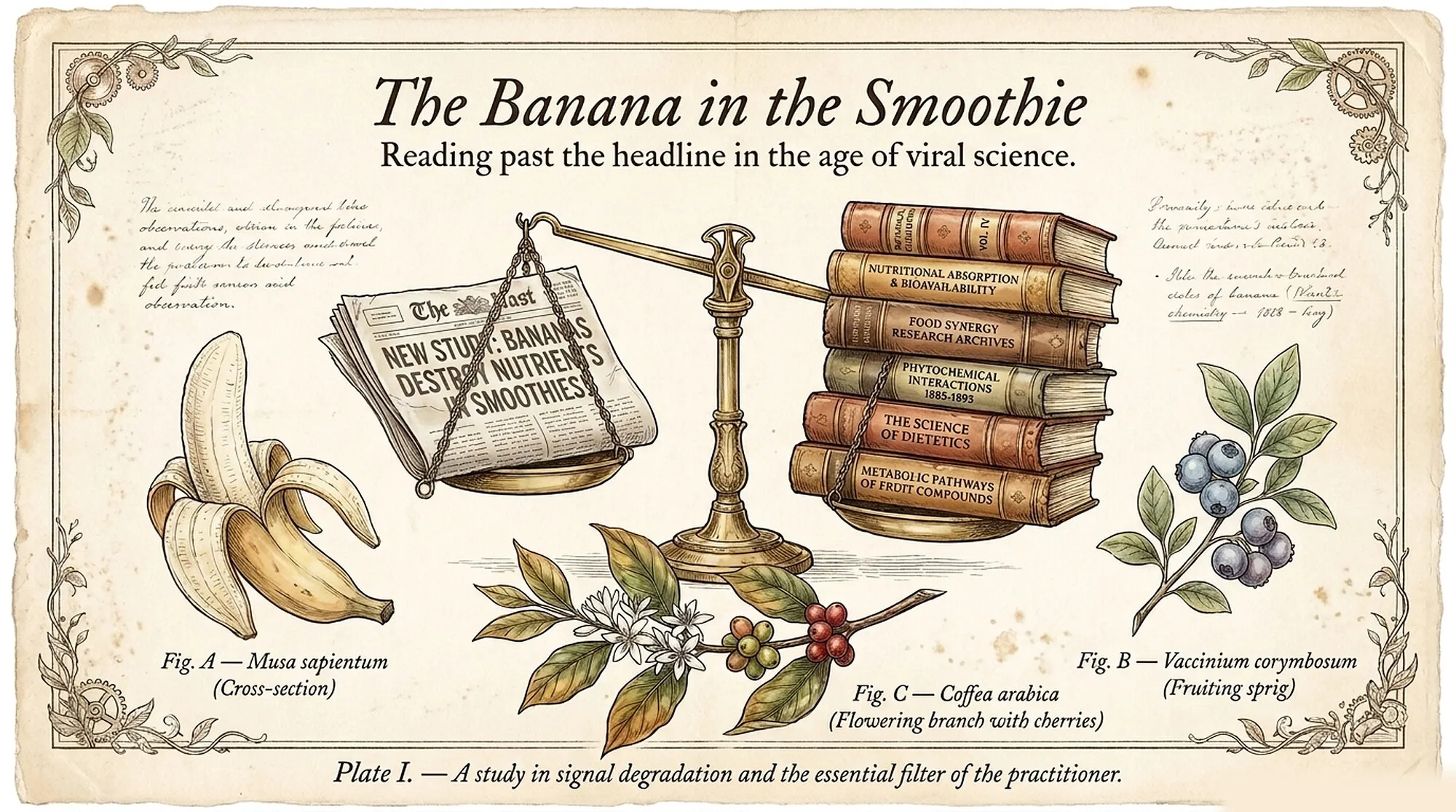
I would be remiss, writing the monthly read of where the field went, if I didn’t mention bananagate. As much as I don’t want to jump on the bandwagon, it is an important lesson to learn, and here is why.
If you missed it: in July, Rhonda Patrick, the PhD behind FoundMyFitness, said on the Mel Robbins podcast, one of the biggest general-audience shows there is, that she skips bananas in her smoothies and uses avocado instead, because a banana can cancel out the antioxidants in your berries. The internet did not adopt the idea. It mocked it, almost immediately, and kept mocking it for weeks.
Here is what the claim rested on. One acute crossover study in eight healthy men, published in Food & Function, found that blending banana into a flavanol drink cut the amount of one antioxidant, epicatechin, that showed up in the blood by roughly 80 percent, because bananas are unusually high in an enzyme called polyphenol oxidase. Real finding. Real mechanism. Eight men, one polyphenol out of the hundreds in food, measured once.
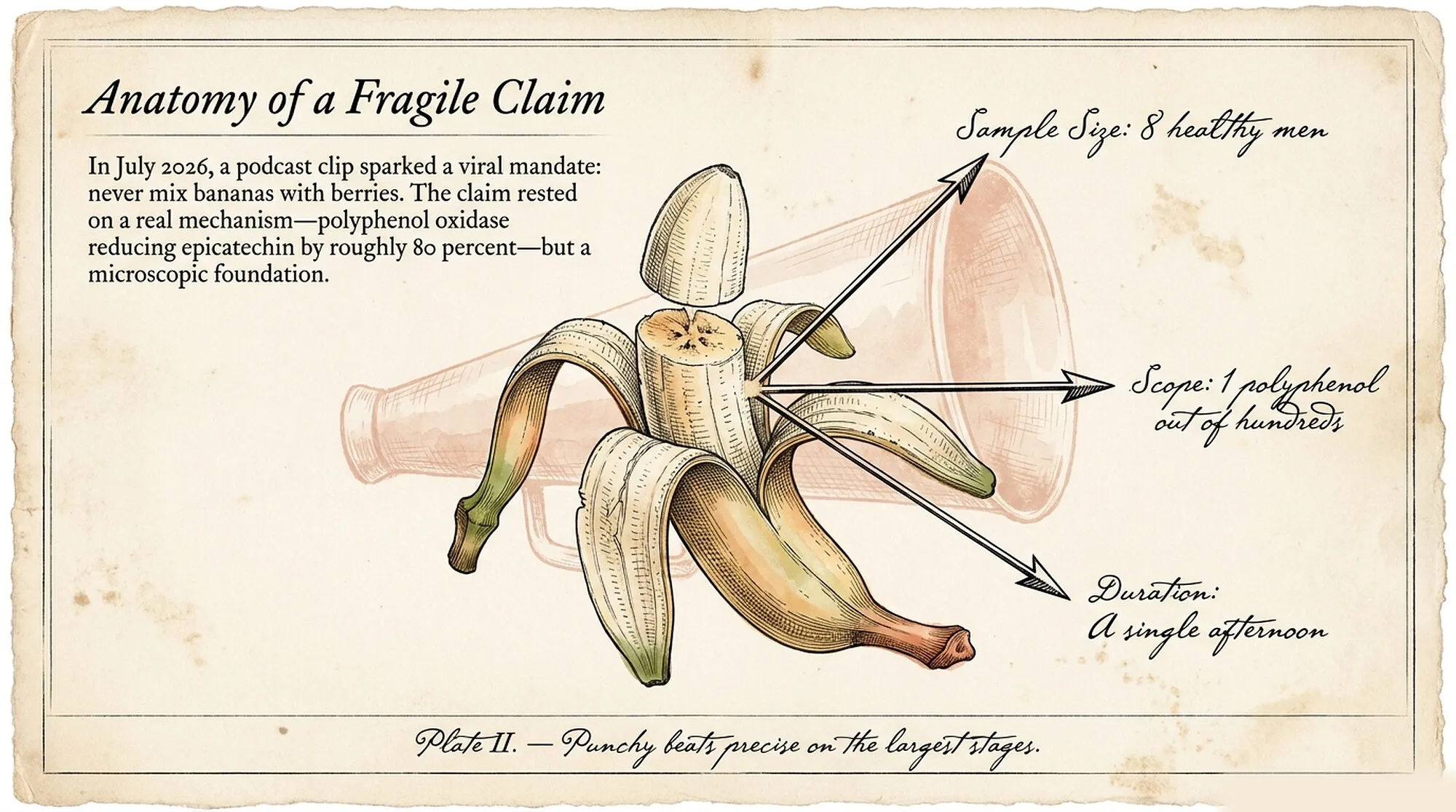
That is a fine footnote and a strange thing to broadcast to a few million people as a reason to change breakfast. The gap between what the study measured and what got said on a stage that size is the whole lesson. A show with that reach is a place where the caveat never makes it out of the room, and the bigger the platform, the more the care becomes the job of the person holding the microphone. That is the part worth sitting with, and it is why bananagate is worth more than a laugh.
The month the field argued about a study, not a diet
Most months the credentialed voices I follow argue about what is true: carbs or fat, fasting or not, lift or run. In July they argued about something more interesting to a coach: how you are allowed to talk about a study you just read.
The mockery had a point, and the point is the lesson. What made it sting is that the careful version existed the whole time, from the same person. Patrick also posted it in writing: “It’s okay to add a banana to your blueberry smoothie. Bananas are nutritious, I eat them, and this is not a reason to stop. But if your goal is to preserve as many of the berry polyphenols as possible, the chemistry matters.” She had the accurate version available. The clip that got attention was the surprising one, said on the biggest stage, where punchy beats precise every time.
Others spent the month naming the pattern directly. Alan Aragon, a nutrition researcher, went through the clip point by point, thanking the show for the material. Precision Nutrition, the largest nutrition-coaching certifier, wrote the sentence I keep thinking about: “Nutrition science doesn’t change nearly as fast as your feed suggests.” A niche enzyme interaction, they noted, gets stretched into “never put bananas in your smoothie again” because novelty plus a little fear is a reliable formula. Surprising claims get shared. Scary ones get saved just in case.
The verdict underneath all of it is quiet and a little uncomfortable: a claim can be true and still be the wrong thing to say. The banana finding is not fake. Blasting it to a general audience as a reason to change what they eat is the part that earned the pushback.
What a study looks like when it earns the change
It helps to have a contrast, because the answer is not “distrust every study.” July also produced research worth taking seriously, and the difference is instructive.
A study published in JAMA in February followed 131,821 people in the Nurses’ Health Study and the Health Professionals Follow-Up Study for up to 43 years. People who drank two to three cups of caffeinated coffee a day had about an 18 percent lower risk of dementia and slower cognitive decline. Decaf did nothing. That is roughly sixteen thousand times the number of people in the banana study, watched for four decades instead of a single afternoon.
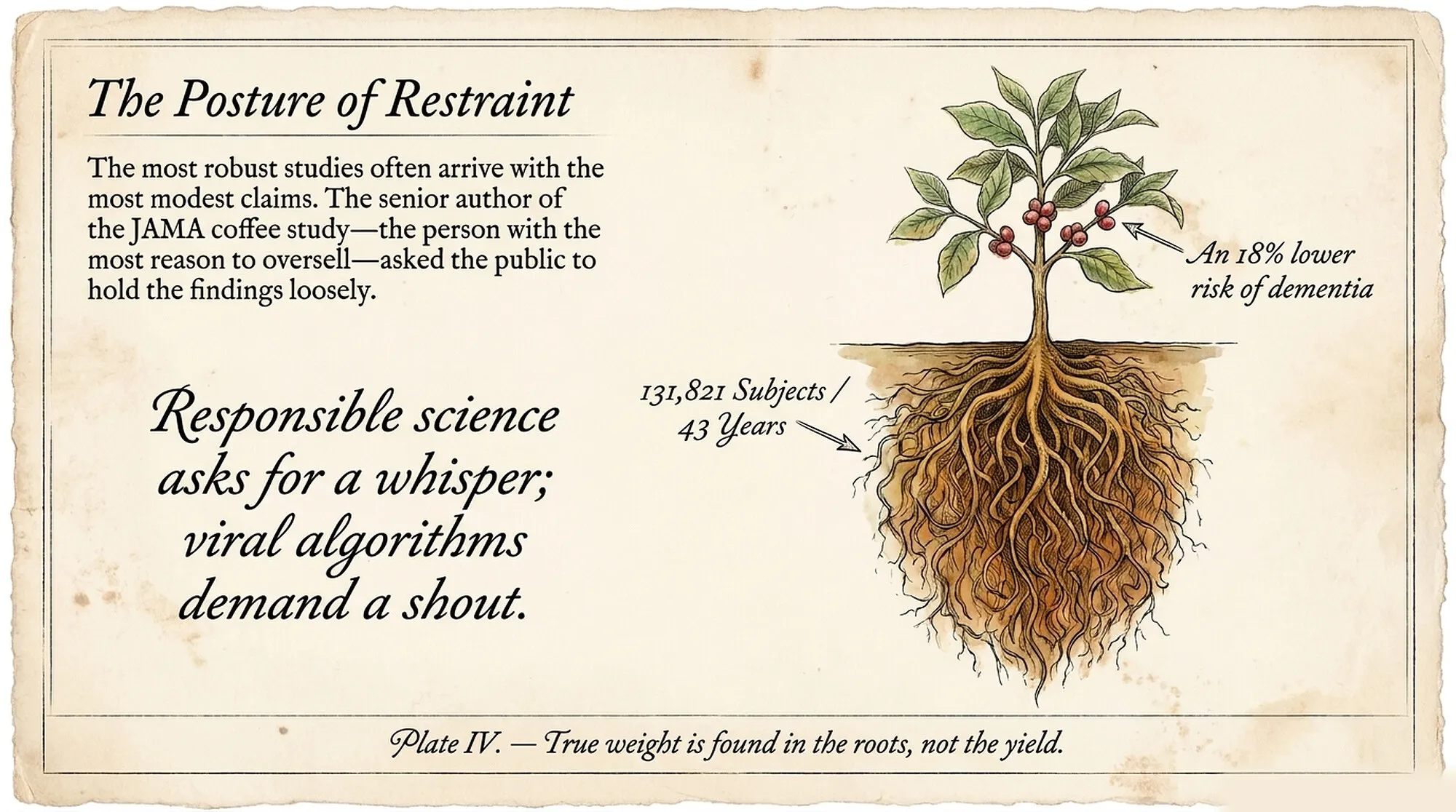
And here is the part the headlines dropped. The study’s senior author, asked about his own result, said the effect size is small and that coffee is at most one piece of a much larger puzzle. The person with the most reason to oversell the finding was the one asking everyone to hold it loosely. That is what responsible looks like, and it is almost never what goes viral.
A study in Neurology in July pooled five aging cohorts, nearly 4,000 adults with an average age of 84, and found that the fastest walkers were about half as likely to develop cognitive impairment, with brain scans that backed it up. When Mark Hyman wrote it up, he actually kept the finding intact: he said cognitive impairment and Alzheimer’s, not death, which is what the study measured. Worth noticing, because the easy version of that post writes itself as “fast walkers live longer,” and that is not what the paper found.
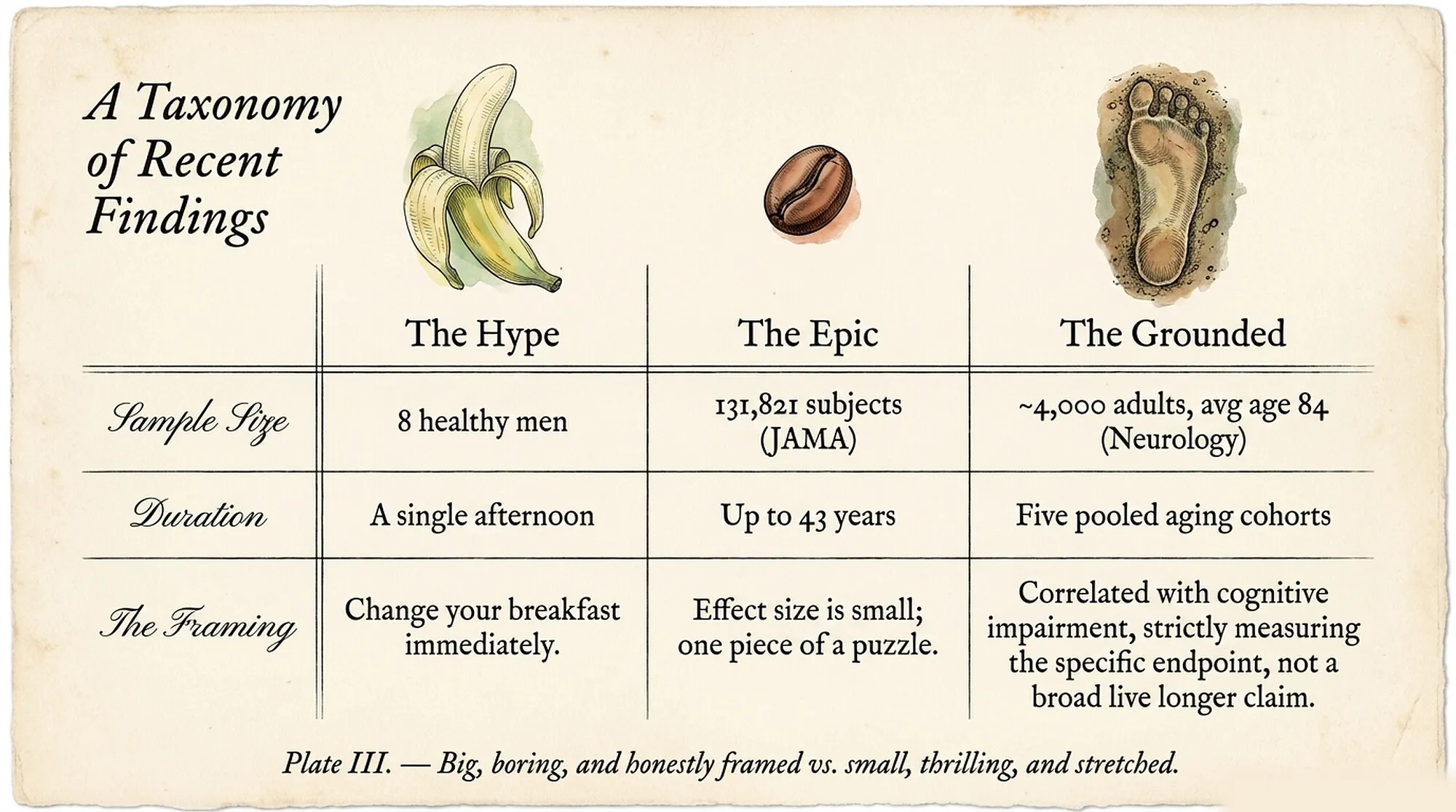
Big and boring and honestly framed. Small and thrilling and stretched past what it showed. Both were real studies. Only one kind has earned a change in what you do on a Tuesday.
The coach is the last honest layer
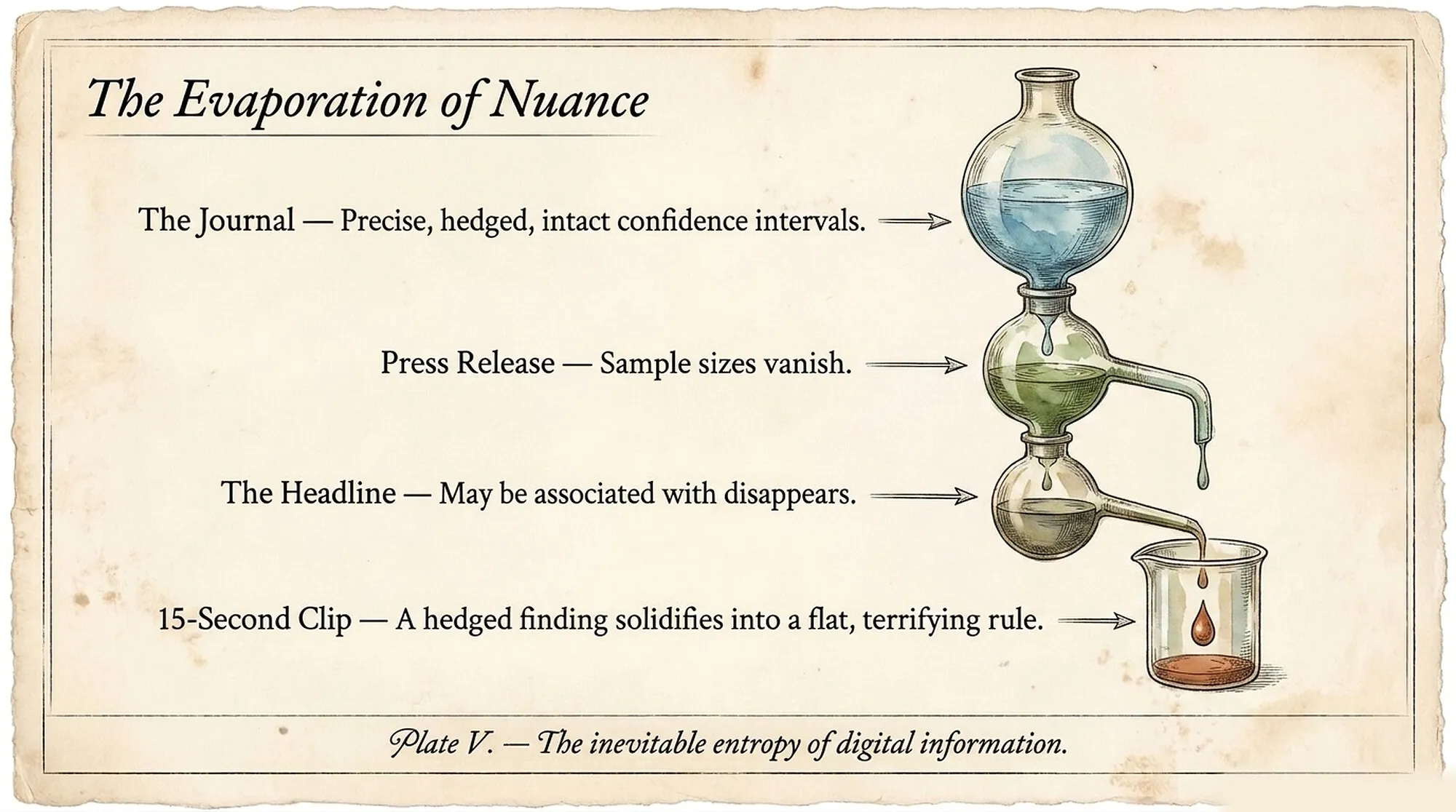
I build software, not coaching practices, so I watch this the way an engineer watches a signal degrade as it passes through a system. A finding starts precise in a journal, loses its confidence interval in a press release, loses its sample size in a headline, and loses its “may be associated with” in a fifteen-second clip. Bananagate got caught because the experts were watching. Plenty of thinner claims do not, and by the time one reaches a person who wasn’t in the room for the correction, a hedged finding has become a flat rule.
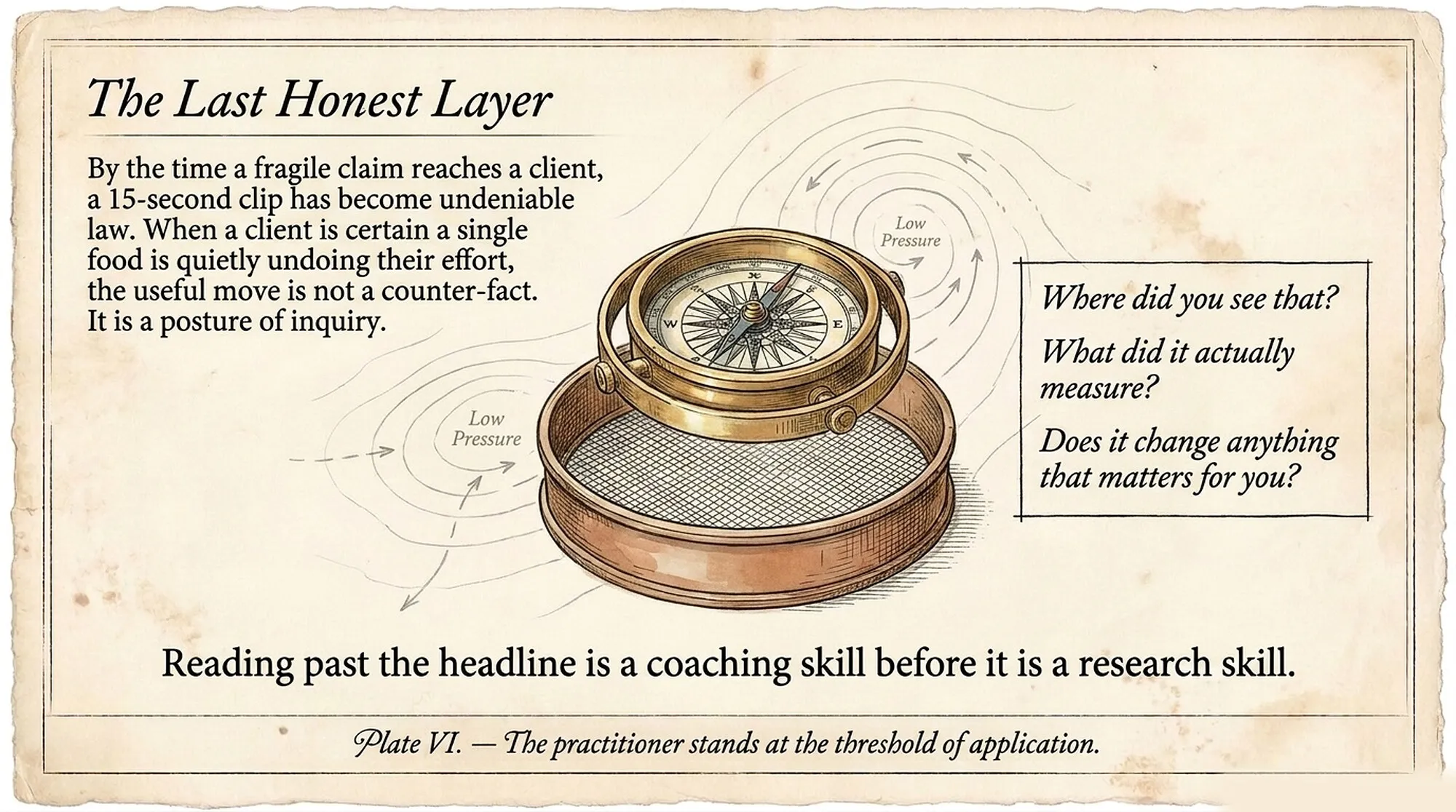
The coach is the last layer before it lands on a real person. That is a strange amount of power to hold over a smoothie, and it is exactly the power the coaches I talk to take seriously. When a client arrives certain that one food is quietly undoing their effort, the useful move is not another counter-fact. It is the same posture the credentialed voices modeled in July: where did you see that, what did it actually measure, and does it change anything that matters for you. Reading past the headline is a coaching skill before it is a research skill.
This is starting to carry more weight than style. In July, CMS released a proposed rule that would establish Medicare payment for health and well-being coaching services beginning in 2027. If coaching is going to be treated as care, then how a coach handles a study stops being a matter of taste and starts being part of the job.
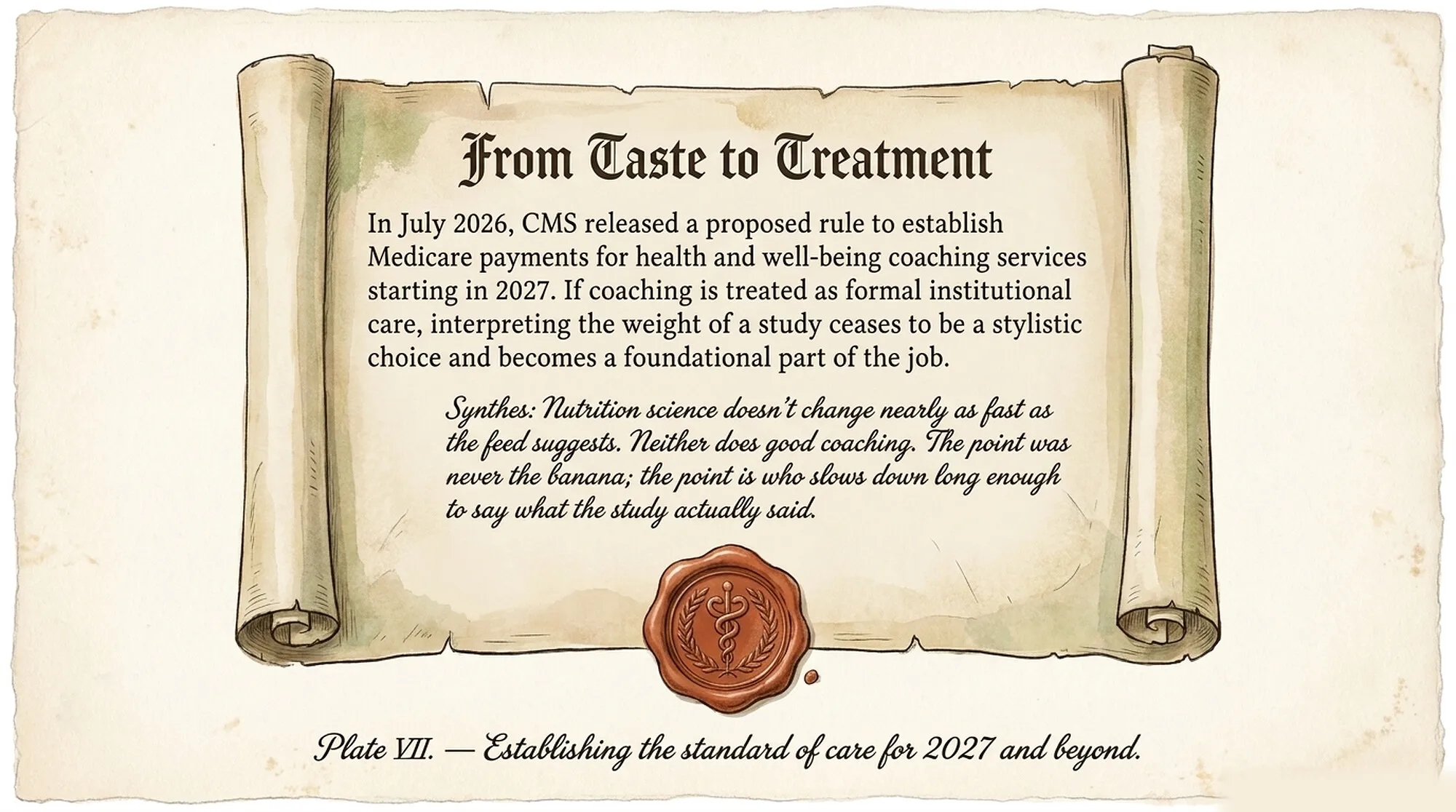
Nutrition science doesn’t change nearly as fast as your feed suggests. Neither does good coaching. The banana was never the point. The point was who slows down long enough to say what the study actually said. (Last month’s read was about a different kind of quiet: independent experts arriving at the same boring conclusion.)

Founder of Grove. Twenty years building software for skilled professionals. Currently writes mostly on Tuesdays from a small studio in Austin.