

You can feel it when a coach has not had time to prep. Nothing goes wrong, exactly. The session just opens a half step behind. The first few minutes go to remembering where you left off instead of getting anywhere new, and you can hear her catching up to her own client in real time.
I have been on both ends of that lag, as the client who felt it and the founder who went looking for where it comes from.
It comes from the few unclaimed minutes before a call. One coach I interviewed reads last session’s notes back to herself before every call, just to remember where they left off. That reading is the prep, and she repeats it from memory, fifteen times a week.
That is the gap Talking Points is built to close.
What the coach gets
Before a session, Sage hands the coach a short set of starting points:
A way to open the conversation, shaped to where this client actually is right now. A small habit or action adjustment worth proposing, when the recent signal suggests the plan has drifted. And a topic worth raising, pulled from the resource library when something there fits what the client is going through.
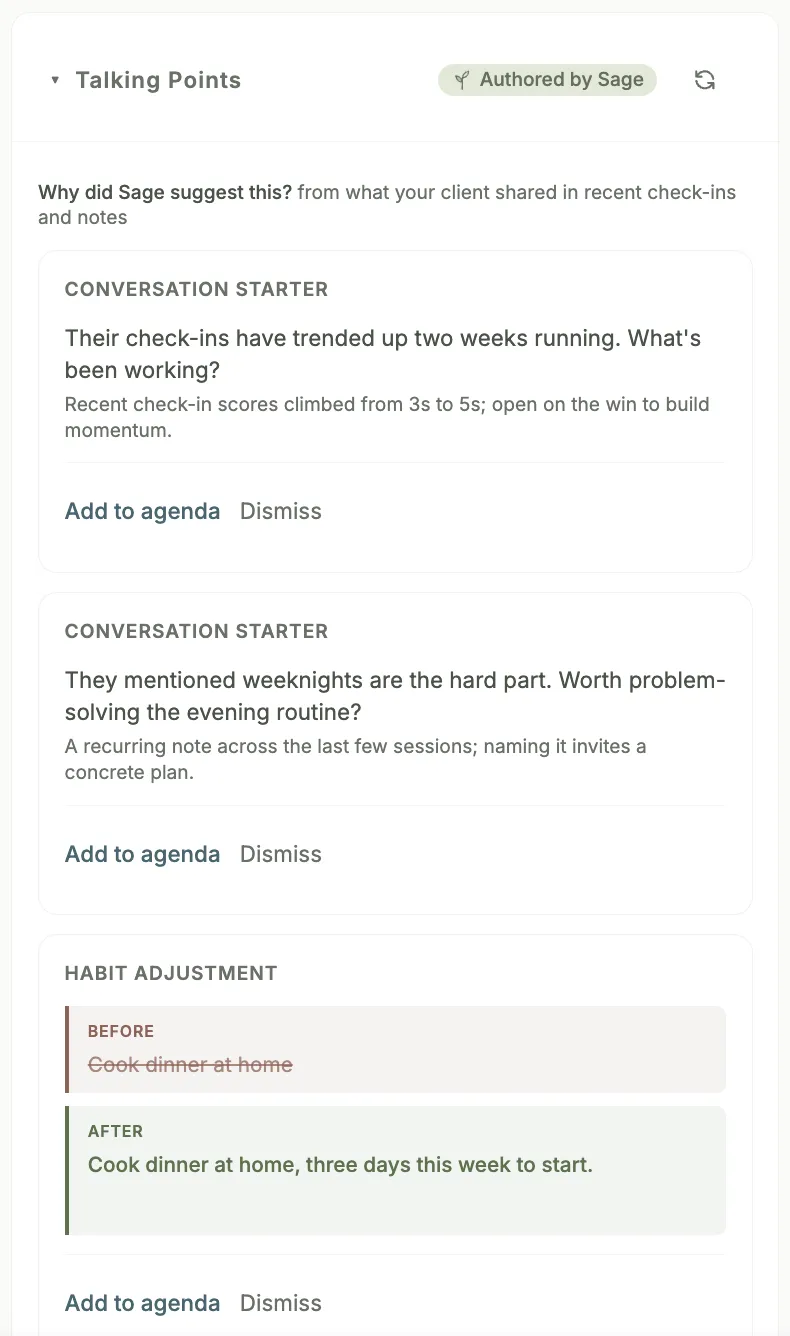
Each one arrives in the session prep already written, marked as Sage’s. The coach edits it, skips it, or promotes it onto the agenda with one tap. The assembly happens out of frame. What the coach sees is the prep, done.
The point is not the draft. It is what the draft frees those five minutes to be. When the prep is already waiting, the time before the call stops going to reconstruction. It goes to the person.
Still a starting point, never a script
Two things stay true, because they are the whole reason a coach can trust any of this.
Sage drafts only for clients who have turned on AI consent, and everything it writes is marked as Sage’s. And every item is a suggestion, not a decision. The coach can lean on one, rewrite it in her own words, or read right past it. The agenda is hers. Sage hands her a place to start and gets out of the way.
Why this is the next thing we built
Last week I wrote about holding the thread, the morning read Sage gives a coach across all her clients. Talking Points is the same idea aimed at one session instead of the whole roster. The Daily Pulse tells a coach what to pay attention to. Talking Points helps her open the conversation in front of her.
Both exist so a coach can spend less of herself on remembering and reconstructing, and more on the part she got into coaching for.
Talking Points is live now. If you coach, I would love to know whether those five minutes before a session feel familiar.

Founder of Grove. Twenty years building software for skilled professionals. Currently writes mostly on Tuesdays from a small studio in Austin.